Breathe. As in. (shadow): Qiu Ruixiang & Peter Welz

The exhibition with Qiu Ruixiang and Peter Welz at HUA International takes inspiration from a poem by Rosamond S. King. In it, breathing is the main theme. Breathing, as if to fade out the environment, turning the focus inward; breathing as if to take stock of what’s there and moving it into the exterior world. Contraction and expansion. King writes “As in subject. As/ in centeroftheworld as in/ mundane.” The shadow is something easily overlooked, something marginal and often forgotten, yet central to our being. The artists play with this notion by willfully surrendering some characteristics to – and rescuing others from – shadow’s embrace.
Ruixiang’s sombre colors and psychological motifs contract universal feelings into individual positions. Peter Welz expands these fragments into colorful new worlds.
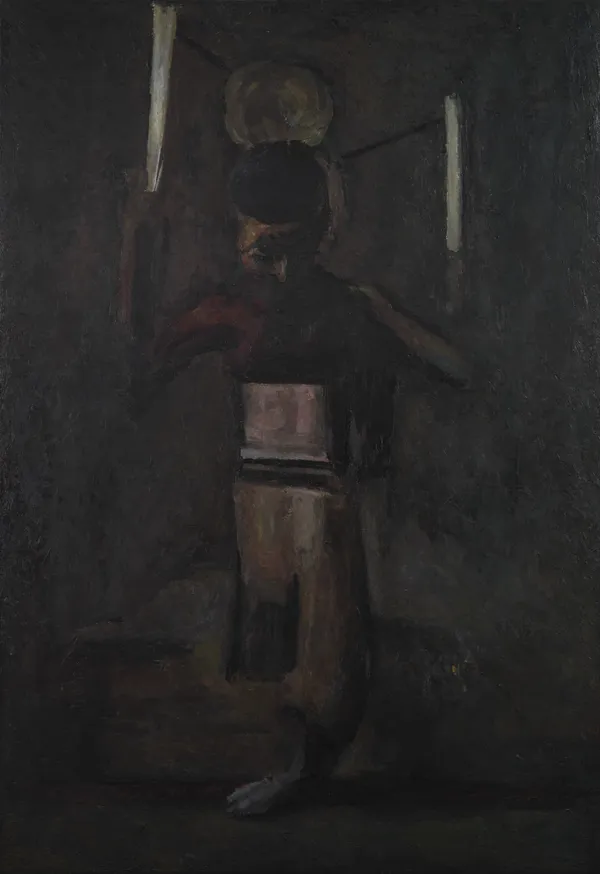
Qiu Ruixiang’s planking figures speak of a solitary endurance. By approaching the individual vis-a-vis society at large, the artist gives form to individual experience. This tendency, which is evident throughout the painter’s oeuvre, makes his work urgent by showing us our own most intimate feelings in the other.
His paintings depict lone figures surrounded by shadows. The dark color palette suggests a turn inward, a movement towards what’s held within. They have an amorphous tendency, the rough outlines and thick layers of oil-paint don’t aim to capture human likeness but rather contain pure emotion. As in King’s poem, Ruixiang’s paintings are a breath inward, a contraction of the environment into the outlines of the figure.
By doing so, the artist cultivates the emotional structure that pervades contemporary society. A kind of weightlessness that emanates from a highly functional social machine, a near universally known state especially prevalent in today’s China. Having willfully isolated himself to fully focus on his paintings for over ten years, Ruixiang depicts psychological states, often grappling with anxiety, angst, and melancholy. He gives room to an individual longing in the face a society peopled by so many, a condition that Olivia Laing describes as “conveying even to the most social a tremor of loneliness, an uneasy combination of separation and exposure”. It is a reduction of a universal feeling to the personal, the contraction of a plurality into something singular.
Qiu Ruixiang’s work will be exhibited alongside a film installation entitled ‘Mapping the figure nude [(xxxxxxxxxxxxxxx) (rainbow)] by the German artist Peter Welz. Reminiscent of the final video of Peter Hujar, taken by David Wojnarowicz immediately after the photographer's death, the work speaks of an intense intimacy. An attempt at capturing all at once, it reveals the impossibility of doing so by simply portraying an object in space. This is perhaps the strongest link between the two artists. Both show the human figure in space, one through painting, the other through video-sculpture. They create a bodily invitation for the visitor to enter, to breathe.
Filming three sculptures of Ugo Rondinone’s series ‘the rainbow body’, Welz zooms in on the figures' limbs, slowly moving along their contours as if caressing them. What emerges from this are colorful outlines that are, at times, out of focus and diffused into shadows. The figures' traces move in and out the screen, relieved of their identity and made into something new. It is an intense exploration, a portrait not necessarily coherent. Rather than reassembling something broken, the artist takes apart Rondinone’s colorful sculptures, insisting that every fragment, while dissolved, is whole by itself.
Where Wojnarowicz attempted to capture the last glimpse of a friend retreating into eternal solitude, as if to photograph the disappearing warmth of the body itself, Welz gives life to the fragments he films, expanding them until they become new worlds made of sheer color. Doing so, the work constitutes a breath outward, an expansion of the captured fragments. Similar to Ruixiang’s work, the characteristics of the figures disappear behind colorful shadows, their identities withheld.