Breathe. As in. (shadow): Qiu Ruixiang & Peter Welz

"The smoke of my own breath / Echoes, ripples, buzz'd whispers" - Walt Whitman, Song of Myself
The exhibition takes its title from a poem by Rosamond S. King, in which the gesture of breathing is held suspended between contraction and expansion, between inhalation and release. It is in this interval, this in-between, that the works of Qiu Ruixiang and Peter Welz find their common ground and their difference: where Ruixiang withholds and compresses, turning the gaze inward, Welz releases and dilates, projecting fragments outward until they constitute new worlds.
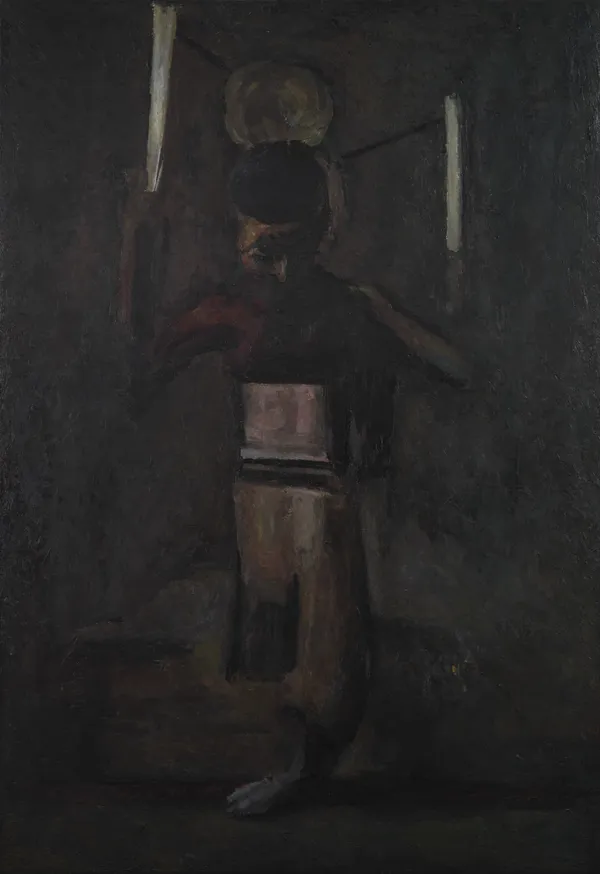
Qiu Ruixiang paints figures that emerge from darkness the way breath fogs cold air without ever fully resolving. Born in Shaanxi province, China, the artist spent over a decade working in near-total isolation, developing a practice built on accumulation and erasure. Working without models or photographic references, he builds his figures through successive layers, like a farmer shaping the earth, he works until a body appears. The works on view are almost exclusively portraits and half-figures: faces held close within the frame, tilted downward, their features are only partially legible : an eye socket scraped into the surface, a jaw that dissolves before it resolve. Light comes from no identifiable source, it seems to secrete from the matter itself, ochres and brick reds breaking through the black ground. The gender of those bodies is indeterminate, their age unreadable and their identity withheld. These works are not portraits in the traditional sense: they refuse the historical promise of portraiture, which delivers recognition, name and taxonomy of the subject. The artist trains the eye in a different discipline, that of remaining with what cannot be decoded. As Olivia Laing writes, a condition that conveys "even to the most social a tremor of loneliness, an uneasy combination of separation and exposure." Qiu Ruixiang does not illustrate this concept, he makes it a formal condition of painting itself. His figures are a breath inward: the contraction of a plurality into something singular.
Peter Welz's video installation Mapping the figure (nude (xxxxxxxxxxxxxxx) (rainbow)) performs the inverse movement. Filming the sculptures of Ugo Rondinone's the rainbow body series through prolonged, extreme close-ups, Welz pushes the camera so deep into painted surfaces that bodies lose their contours entirely: a limb becomes a field of orange, a torso becomes a landscape of red and yellow light. Projected onto a freestanding screen placed at the center of the gallery and simultaneously onto the surrounding walls, the work floods the space with color. This is not the darkness from which Qiu's figures emerge, it is its exact opposite: an expansion so intense that identity dissolves not into shadow but into luminous matter itself. As a trained sculptor, Welz places projected light where shadow would reside, erasing through saturation rather than obscurity. The central screen invites the visitor to walk around it, to pass behind the image, to be traversed by light. This is the strongest formal link between the two artists: both make the body a physical experience for the viewer, one through the accumulated matter of paint, the other through the movement of projected light.
Shadow is the condition that both unites and separates them. In the paintings of Qiu Ruixiang, figures are shadows gaining presence without ever fully detaching from the ground. In the work of Peter Welz, projected light performs the same dissolution from the opposite direction: color saturates form until the body's edges disappear not into darkness, but into radiance. Shadow is therefore both origin and destination, the starting point and the place of return of an exhibition that proposes, in the spirit of Whitman, a slowed experience of looking in which meaning unfolds through breath, gesture and time.